Credit...Nathalia Angarita for The New York Times
Colombia’s President, an Outspoken Trump Critic, Heads to the White House
President Gustavo Petro of Colombia and President Trump have had a tense relationship that escalated into threats by Mr. Trump, before easing. Anything could happen at their Feb. 3 meeting.
by https://www.nytimes.com/by/annie-correal, https://www.nytimes.com/by/max-bearak · NY TimesAs he prepared for his first face-to-face visit with President Trump, President Gustavo Petro of Colombia had been on his best behavior, focused mainly on combating groups involved in the drug trade — Mr. Trump’s stated priority for leaders across Latin America.
But just days before Tuesday’s meeting, he appeared to lapse into an old habit: lobbing verbal mortars at Mr. Trump.
In public remarks last week, Mr. Petro, an avowed leftist, spoke of “genocide in Gaza,” criticized the mistreatment of migrants in the United States and said that Venezuela’s president, Nicolás Maduro, had been “kidnapped” by the United States and should be returned to Venezuela to stand trial.
The comments alarmed his advisers as well as experts, heightening fears that the visit could go less smoothly than Mr. Petro’s recent, nearly hourlong call with Mr. Trump did. That could have long-lasting ramifications in a region already reeling from Mr. Maduro’s capture.
The meeting between the two leaders — arranged after Mr. Trump threatened Mr. Petro with military action — is meant to de-escalate tensions, diplomats said. It is also meant to address topics such as “the fight against transnational organized crime, especially on the border,” according to Colombia’s foreign ministry.
But that plan could easily veer off course given that both presidents share a common trait: a willingness to speak their minds no matter the consequences.
“In a word, they’re unpredictable,” said Julio Londoño Paredes, a retired Colombian Army lieutenant colonel, diplomat and former foreign minister who is part of a group of foreign policy advisers who met with Mr. Petro to prepare for the visit.
The two men have said little about their meeting, though on Sunday, before departing for the United States, Mr. Petro called for Colombians to take to the streets on the day he meets with Mr. Trump. Colombia’s government did not respond to questions for this article, but both Colombian and U.S. officials said the meeting was expected to be private.
The United States and Colombia have been staunch allies for decades and have much to gain from cooperating as U.S. officials try to stabilize Venezuela, Colombia’s neighbor, experts say. Yet Mr. Trump has been known to ambush leaders in the Oval Office, and Mr. Petro has been known to provoke — and to be easily provoked.
“My concern is that he could be triggered,” Gimena Sánchez, a Colombia specialist at the Washington Office on Latin America, said of Mr. Petro. “When he gets triggered he has no filter. He’s capable of saying anything.”
The question is not whether Mr. Petro is going to change his “style,” said Juan Carlos Flórez, a Colombian historian and politician, but rather, “is he prepared for that sort of ambush?”
Mr. Petro and Mr. Trump also have nearly opposing views on the U.S. role in Latin America. Mr. Trump wants the United States to exert dominance over the entire Western Hemisphere, while Mr. Petro spent some of his formative years as a member of an anti-imperialist urban guerrilla group.
The Colombian leader is nearing the end of his four-year tenure and is limited to one term with elections scheduled for May. Polls suggest a fairly close race between an ally of Mr. Petro and a conservative candidate, but with the race still months away, it remains unclear who might gain the upper hand. Some experts also wonder if anti-Petro Republicans in Washington will try to influence the outcome and if Mr. Trump will endorse a candidate, as he has elsewhere in Latin America.
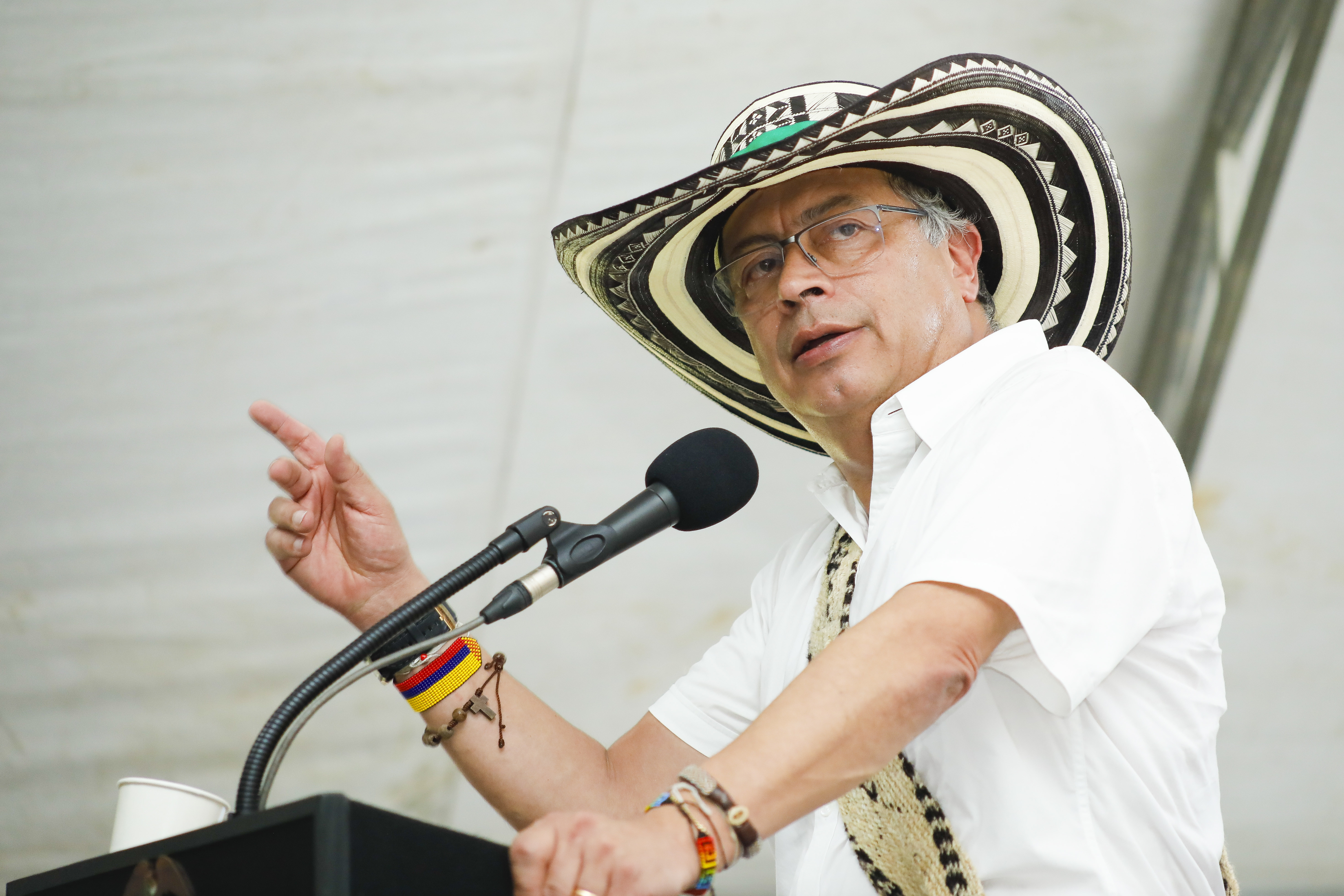
Adding to the uncertainty over their meeting, Mr. Petro does not speak English, which experts say puts him at a disadvantage with Mr. Trump. He also tends to disdain the pomp that Mr. Trump relishes, preferring guayaberas and traditional Colombian woolen “mochila” bags to suits and briefcases.
Colombia’s ambassador to the United States, Daniel García-Peña, is charged with crucial details of the visit, including securing Mr. Petro’s gift to give to Mr. Trump and his punctual arrival, Mr. Londoño said. Mr. Petro is often hours late, even to important occasions.
Trump Administration: Live Updates
- Pirro threatens jail time for lawful gun owners who travel to Washington with a firearm.
- The Justice Department failed to alert a judge to a press law in its application to search a reporter’s home.
- Federal judge blocks end of protection for Haitians in the U.S.
Mr. Petro’s advisers have tried to instill the importance of “prudence,” Mr. Londoño said, adding that Mr. Petro had been advised to avoid subjects that could “derail” the conversation. The president is fond of extemporizing on human rights and clean energy, far from Mr. Trump’s favorite topics.
Mr. Petro has in the past accused Mr. Trump himself of committing abuses. In an interview last month with The New York Times, he called U.S. immigration authorities “fascist,” and, asked if he had been told to avoid inflammatory language at the White House, he said, “I have to say what I think.”
Mr. Petro’s main interest as president is being seen as an international champion for progressive causes, said Alejandro Gaviria, who served as a minister in Mr. Petro’s government and wrote a book about him.
“That’s been his great ambition,” he said. “More than governing Colombia — it’s to be someone whose opinions carry weight on the global stage.”
At the White House, Mr. Petro might be torn between that ambition and the need to show restraint to keep himself, and Colombia, out of Mr. Trump’s sights. (Mr. Trump has accused Mr. Petro, among other things, of being a drug trafficker, which experts describe as a baseless claim).
“We will get to see whether he behaves like a president, or an activist,” said María Jimena Duzán, a prominent Colombian investigative journalist.
One concrete sign of the fragile state of Mr. Petro’s standing is that the United States had to grant him a short-term visa so he could enter the country.
Mr. Petro’s visa was revoked in September after he told U.S. soldiers to defy Mr. Trump at a pro-Palestine rally in New York City. Soon after, he was sanctioned by the United States after accusing Mr. Trump of “murder” over the U.S. military’s boat strikes in the Caribbean and Pacific.
In his recent public remarks, Mr. Petro suggested that he would like his visa reinstated so he could see a Broadway show. He also joked about asking Mr. Trump if he preferred wine or whiskey at their White House meeting in a tone, Mr. Gaviria said, that suggested “he thinks he can jibe” with the U.S. president. (Mr. Trump says he does not drink.)
Juan Gabriel Tokatlian, an international relations expert who specializes in Colombia, said it would be a mistake for Mr. Petro to broach any personal matters.
Instead, he said, Mr. Petro should focus on how the two countries can work together. Colombia is not a “frontline state” in the fight against fentanyl, like Mexico, Mr. Tokatlian said. (Colombia is not known to produce fentanyl.)
But Colombia does share a roughly 1,375-mile border with Venezuela, and armed groups like the Colombian-born National Liberation Army, or ELN, move cocaine from Colombia across the border toward Venezuela’s Caribbean ports, he said.
The Trump administration needs Mr. Petro’s help to curb that traffic.
Mr. Petro, for his part, needs the United States to ensure that Venezuela’s transition from Mr. Maduro does not devolve into political infighting or unrest.
“An out-of-control situation in Venezuela would severely affect Colombia — in terms of migrants, trade relations and armed actors,” Mr. Tokatlian said. “So Petro could do well to transmit that he is someone willing to help contribute to that stabilization.”
Mr. Trump may also want to ensure Colombia’s presidential elections remain on track for May, experts said. Mr. Petro, in his phone call with Mr. Trump, said he warned him that any U.S. interference in Colombia would result in violent “convulsions” that could forestall elections.
If the two can stick to issues of common concern, Mr. Tokatlian said, “I think it can go — not supremely well — but relatively well.”
It is in neither leader’s interest to confront the other, experts agreed.
Mr. Trump could punish Colombia with tariffs, causing economic pain that could damage the left’s chances in the upcoming elections. A confrontation with Mr. Petro could be counterproductive for Mr. Trump, too.
Mr. Trump’s criticism has only boosted the Colombian president’s popularity, said Ms. Duzán, the journalist. Any public scolding at the White House could likewise work in Mr. Petro’s favor, pushing more voters to the left.
“It could move the pendulum,” Ms. Duzán said.
Edward Wong contributed reporting from Washington.