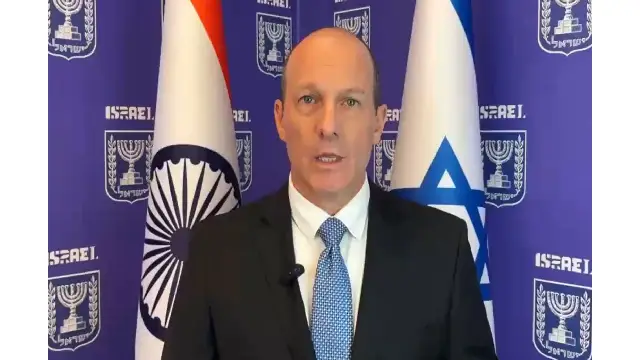
Israeli Envoy Reuven Azar Says “Terror Has No Borders” on First Anniversary of Pahalgam Attack
by KalingaTV Bureau · KalingaTVAdvertisement
New Delhi: Israeli Ambassador to India, Reuven Azar, led the global remembrance of the barbaric terror attack in Pahalgam, Kashmir, as the international community reaffirmed its solidarity with New Delhi on the first anniversary of the deadly strike that occurred in April 2025.
In a video message shared on X, the Ambassador paid tribute to the victims, stating, “Today, India marks one year since the barbaric terror attack in Pahalgam, Kashmir, where 26 innocent lives were lost.” Conveying his condolences to the bereaved, Azar added, “On behalf of Israel, I extend our deepest condolences to the families of the victims and to the people of India. We stand with you in grief and in solidarity.”
Drawing a parallel between the security challenges faced by both nations, the envoy highlighted that “this pain is deeply familiar” following the events of 7 October. “This attack reminds us that terror has no borders,” he noted, asserting that New Delhi and Jerusalem remain “committed to confronting this threat together with resolve and determination.”
The 22 April 2025 attack, which saw Pakistan-backed terrorists strike the scenic tourist town in Jammu and Kashmir, remains a grim milestone that has drawn continued global condemnation.
Argentine Ambassador to India, Mariano Caucino, joined the remembrance on X, marking “one year since the tragedy of the Pahalgam terror attack against India.” He conveyed a tribute on behalf of the Argentine people, stating that the victims “shall never be forgotten,” and reaffirmed his nation’s stance in “condemning terror in all its forms.”
The global assembly of support further included Kyunghoon Kim, Head of the India and South Asia Team at the Korea Institute for International Economic Policy, who highlighted the recently announced “Joint Strategic Vision for the India-ROK Special Strategic Partnership.” Kim noted that both sides have called for the “perpetrators, organisers, and financiers to be brought to justice without further delay” and agreed to enhance cooperation to “root out terrorists’ safe havens.”
Australia’s High Commissioner to India, Philip Green, echoed these sentiments, stating that Canberra joins its “Indian friends & colleagues” to honour the victims and their families. “Australia stands against terrorism in all its forms,” Green posted on X, as various nations renewed calls for enhanced cooperation against cross-border threats.
Advertisement
The attack occurred when terrorists entered a village in Pahalgam and killed 26 civilians. In a chilling detail of the cross-border communal attack, the assailants reportedly questioned the victims about their religion before killing them.
The killings prompted a decisive military response from the Indian armed forces in the form of ‘Operation Sindoor’. Launched on 7 May 2025, the operation saw Indian armed forces strike terror infrastructure across Pakistan and Pakistan-occupied Jammu and Kashmir (PoJK).
Official details confirm that Indian forces destroyed nine major terror launchpads linked to Lashkar-e-Taiba, Jaish-e-Mohammed, and Hizbul Mujahideen, eliminating over 100 terrorists. This led to a four-day conflict involving drone attacks and shelling, during which India conducted retaliatory strikes, destroying radar installations in Lahore and near Gujranwala.
Following the heavy damage inflicted by Indian forces, a ceasefire was agreed on 10 May after Pakistan’s Director General of Military Operations (DGMO) contacted the Indian DGMO.
The security forces subsequently achieved further success with ‘Operation Mahadev’, a joint effort that tracked down and eliminated three terrorists directly involved in the Pahalgam attack. Alongside these military actions, India took stringent non-military steps, including the termination of the Indus Waters Treaty and all bilateral trade with Pakistan.
(ANI)
Also Read : Trump demands release of 8 Iranian women ahead of high-stakes Islamabad Talks
Advertisement